The 45 Rule in Killer Sudoku, Explained
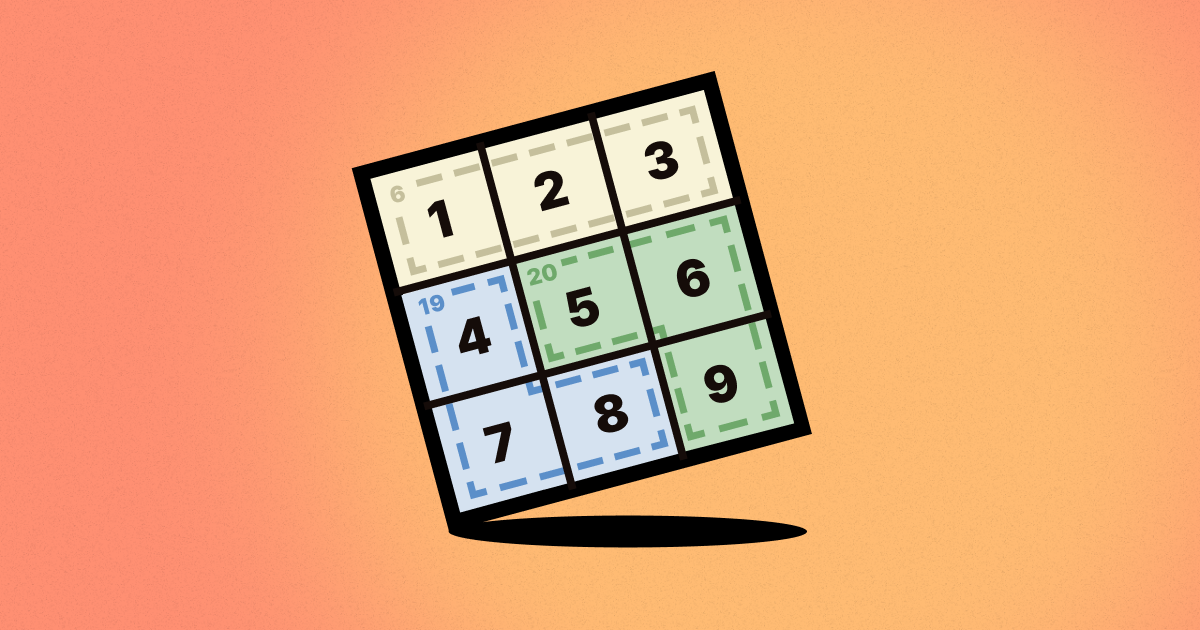
1 + 2 + 3 + 4 + 5 + 6 + 7 + 8 + 9 = 45. That single line of arithmetic, applied relentlessly, is the whole rule.
Solvers sometimes call it "the secret," after a running joke on the Cracking the Cryptic channel. If the cage rules are still new to you, start with how to play Killer Sudoku.
The 45 Rule in Practice
Single box application
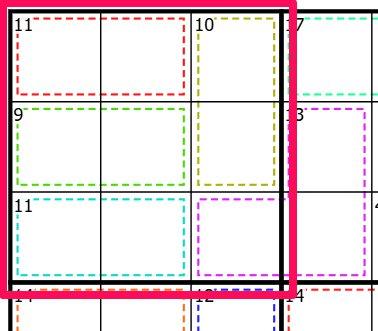
Look at the top-left box. Four cages sit inside it: 11 across r1c1-r1c2, 10 down r1c3-r2c3, 9 across r2c1-r2c2 and 11 across r3c1-r3c2. Every one of them lies entirely within the box. Together they cover eight of the nine cells and total 41.
The box has to total 45. So the ninth cell, r3c3, is 45 − 41 = 4.
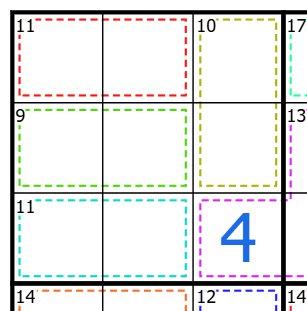
That is a placed digit on a grid with no givens, from arithmetic alone. Two conditions made it legal, and both matter:
- Every cage counted lies entirely inside the box. Not most of it. All of it.
- Exactly one cell is unaccounted for.
Nothing about that is box-specific. The same subtraction works on any house — row, column or box.
Single column application

Four cages down column 1 total 8 + 12 + 15 + 7 = 42 across eight cells. The bottom cell is 45 − 42 = 3. Same move, different house.
A caveat on both examples: each one assumed the leftover cell was caged. Some Killer Sudoku do leave a few cells bare, but most cage all 81. In those puzzles the leftover cell still belongs to a cage — one that crosses the region boundary — and the subtraction works exactly the same way. That cell also has a name.
Innies and Outies
Two terms do a lot of work here:
- Outie — a cage pokes out of the region you are counting. The cell sticking out is the outie.
- Innie — the cages tile the region except for one cell, and that cell belongs to a cage lying mostly outside. The uncovered cell is the innie.
Working an outie
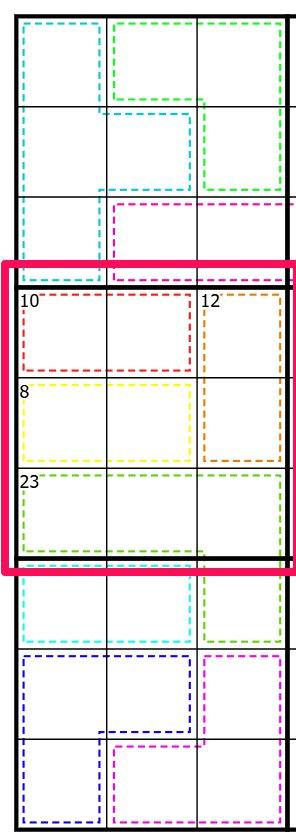
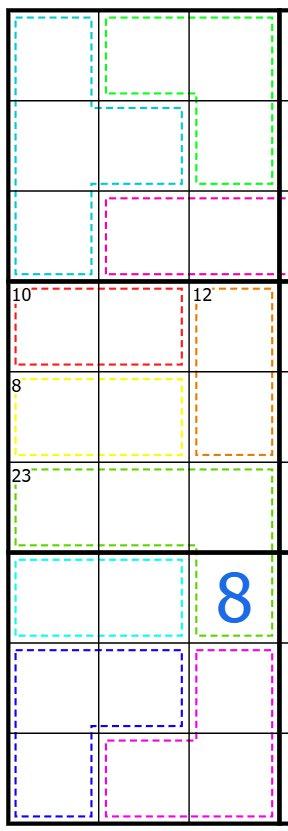
In this example, three cages sit inside box 4 (the middle one): 10, 12 and 8. A fourth cage, 23, covers the box's bottom row and then drops one cell into the box below.
Count everything, including the cage that pokes out: 10 + 12 + 8 + 23 = 53, spread across 10 cells. Nine of those cells are the box, which totals 45 (because 1 + 2 + 3 + 4 + 5 + 6 + 7 + 8 + 9 = 45). The tenth is the outie.
53 − 45 = 8. The cell at r7c3 is an 8.
Working an innie
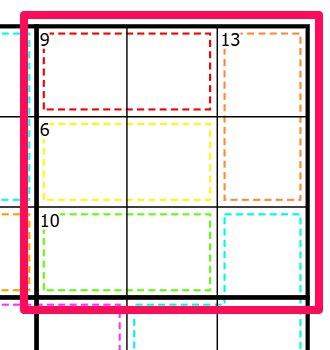
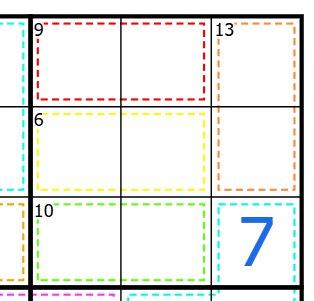
Now in this one, four cages lie fully inside box 3 and total 9 + 13 + 6 + 10 = 38 across eight cells. The ninth cell, r3c9, belongs to a cage running down into box 6, so it never entered the count.
45 − 38 = 7. The innie is a 7.
Innies and outies are not a separate technique. They are the 45 rule pointed at a cell instead of a region.
They are also how you will meet the rule almost every time, and that follows from the geometry rather than from anyone's opinion. In a grid where all 81 cells are caged, a leftover cell has to belong to some cage. If that cage were fully inside the region, you would have counted it and there would be no leftover. So the cage must cross the boundary, which makes the cell an innie or an outie by definition. The clean uncaged-leftover case above is the exception; this is the rule.
Some older strategy sites call the same two quantities the "inside total" and "outside total." The vocabulary differs, the arithmetic does not.
But there are three ways this can go wrong:
- Counting a cage that isn't fully inside. This is the big one. Every cage in an innie count must lie entirely within the region, or you are doing outie math without realizing it.
- Double-counting a shared cell. Trace the region boundary before you add anything.
- Forgetting the leftover can be more than one cell. If cages total 37 across seven cells, then 45 − 37 = 8 belongs to two cells, not one. You have learned their sum, not their digits.
When the leftover is two cells
A two-cell leftover feels like a dead end. It isn't — you have just built yourself a cage that the setter never drew.
Say the count leaves 8 across two cells. Both sit in the same box, so they can't repeat, which rules out 4+4 and leaves exactly three options: 1+7, 2+6 or 3+5. Between them those pairs use only 1, 2, 3, 5, 6 and 7. Neither cell can be a 4, an 8 or a 9 — three candidates eliminated from two cells before you have placed anything.
Now push it. If those two cells also share a row, and that row already holds a 7, then neither of them can be the 7 — so 1+7 dies outright. Note the "both" there: barring one cell from 7 achieves nothing on its own, because the other cell could still take it. With the pair gone you are left with 2+6 or 3+5, which kills the 1 as well. Two cells, five dead candidates, all from one subtraction.
That is the handoff this page is built around: the 45 rule finds the sum, and the Killer Sudoku cage combination table finds the digits. Neither is worth much without the other.
The Multiple-45 Rule
The rule scales. Two houses taken together must sum to 90. Three sum to 135. Any n houses sum to 45n.
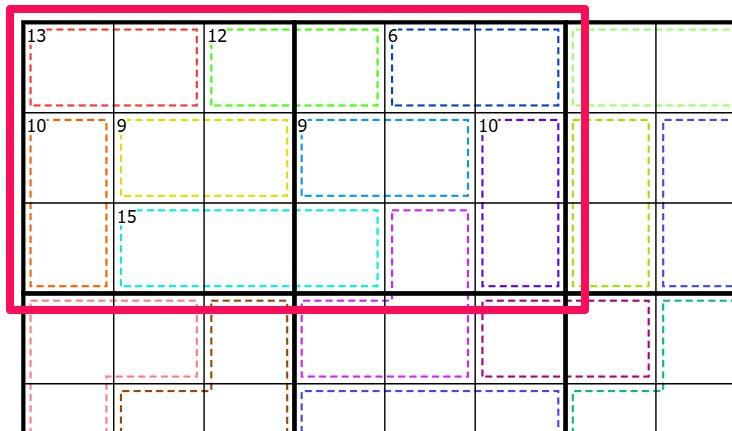
Neither box gets you anywhere alone. In box 1, only three cages lie fully inside — 13, 10 and 9 — covering six cells for a total of 32, which leaves three cells loose. Box 2 is no better: 9, 6 and 10 cover six cells for 25, leaving three loose. Two cages, the 12 and the 15, straddle the boundary and spoil both counts.
Take the boxes together and the picture changes. Now those two crossing cages are inside the region, and eight cages tile 17 of the 18 cells:
13 + 10 + 9 + 12 + 15 + 9 + 6 + 10 = 84
Two boxes total 90. 90 − 84 = 6, so r3c5 is a 6.
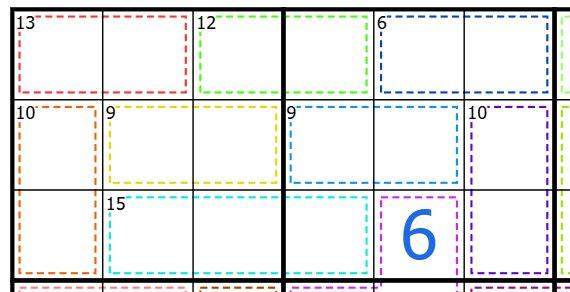
The arithmetic never gets harder — it is still one subtraction. Choosing the region is the skill, and spotting which combined area is almost tiled is what expert grids demand. Our expert Killer Sudoku grids assume you can do this; it is one of the techniques the difficulty grading actually checks for.
Advanced trick: cast out 45s instead of computing 45n
Across three or four houses the totals get clumsy. You don't need 45n, though — you need the gap. Add cage sums in a running total and subtract 45 whenever you pass it. Whatever remains at the end, subtract that from 45.
Three boxes with cages totaling 127: 127 − 45 − 45 = 37, and 45 − 37 = 8. That is the same answer as 135 − 127, reached with smaller numbers along the way. This works for any leftover under 45, so every single-cell and small-group deduction qualifies.
When to Reach for It
Knowing the rule is easy, but noticing when it applies is the part that takes practice. Four triggers:
- A house where cages nearly tile it. One or two loose cells is the shape you want.
- A cage protruding exactly one cell past a region boundary. That is an outie, free of charge.
- Grid edges and corners. A cage in the middle of the grid can sprawl in four directions. A cage in a corner box has two of those directions walled off, so it is likelier to sit wholly inside its box — which is exactly the condition the rule needs. Check the corners first.
- The opening move. On an empty grid, the 45 rule and unique cage combinations are the only two entry points that exist. Stuck before you have placed anything? This is the move.
One more habit worth building: after a 45-rule placement, stop counting and work the consequence. A placed digit prunes its row, its column, its box and its cage all at once, and that pruning often hands you an ordinary hidden single somewhere else. Solvers who chain three 45 calculations in a row before touching the grid are usually the ones who make an arithmetic slip.
In easy grids you might never need any of this. From medium grids and beyond it is load-bearing, and by expert level it is a required level of skill.
What Is the 45 Rule in Killer Sudoku?
The 45 rule states that every row, column and 3x3 box in a Killer Sudoku sums to 45, because each one holds the digits 1 through 9 with no repeats. Because Killer Sudoku labels its cages with sums, you can add up the cages covering a house and compare that figure against 45. The difference belongs to whatever cells your count missed or overshot — and when the difference covers exactly one cell, you have placed a digit.
What's the best Killer Sudoku strategy?
There isn't one. The working pair is the 45 rule and unique Killer Sudoku cage combinations, and nearly every harder technique builds on those two. The 45 rule tells you what a group of cells must sum to; combination logic tells you which digits can produce that sum. Learn both, use them together, and you can finish most grids up to expert.
What Is the 3-Number Rule in Sudoku?
In classic Sudoku, "the 3-number rule" usually refers to triples: when three cells in a house can only hold three candidate digits between them, those digits are locked into those cells and can be struck from everywhere else in the house.
It works the same in Killer Sudoku, with a bonus. Three-cell cages carry a sum too, and a few of those sums are unique — a 3-cell cage totaling 7 can only be 1, 2 and 4 — which the Killer Sudoku combinations guide lists in full.
Frequently Asked Questions
Does the 45 rule work on rows and columns, or just boxes?
All three. Any house — row, column or box — holds the digits 1 through 9 once and sums to 45, so the same subtraction applies everywhere.
What if two cells are left over instead of one?
You learn their sum, not their digits. That is still useful: a two-cell leftover of 8 has to be 1+7, 2+6 or 3+5, which often collides usefully with candidates you have already penciled in.
What's the difference between an innie and an outie?
An innie is a cell inside your target region that your cage count missed, found with 45 minus the inside total. An outie is a cell outside your target region that your cage count swept in, found with the outside total minus 45.
Do I ever need more than two boxes at once?
Rarely below expert. Extreme grids occasionally demand three-region sums, but if you are counting three houses on a medium puzzle, there is almost certainly a simpler move you have walked past.
Is using the 45 rule cheating?
No. It is derived from the rules of Sudoku rather than imported from outside them, and Killer Sudoku is designed around it. Setters count on you finding it — that is why cages are placed to straddle boundaries in the first place.
Count Your Way to Winning!
The 45 rule is the difference between staring at an empty grid and making your first placement inside 30 seconds. Today's puzzle is one click away, and the medium tier is the first difficulty level where the rule earns its keep!
 Mini Crossword
 Midi Crossword
 Diffle
 Killer Sudoku
 Numberle