How to Play Killer Sudoku — Rules, Cages, and Your First Solve
How to Play Killer Sudoku — Rules, Cages, and Your First Solve
TL;DR - Killer Sudoku follows every normal Sudoku rule — fill each row, column and 3x3 box with the digits 1-9 exactly once — plus two more: the digits inside each dotted cage must add up to the small number in its corner, and no digit repeats inside a cage. There are no given digits to start from; the cage sums are all the information you need. Every puzzle here has exactly one solution and can be finished by logic alone, no guessing needed.
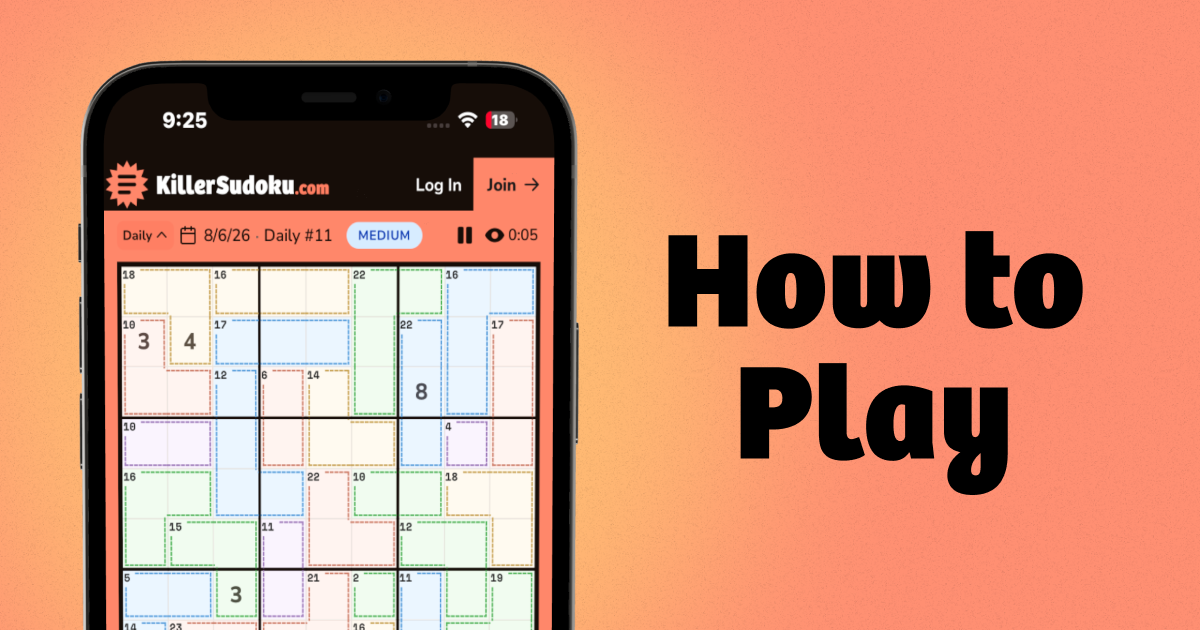
Killer Sudoku is one of the most well-known variations of Sudoku. Its core rules remain the same: fill each row, column and 3x3 box with the digits 1-9 exactly once. What makes it branch off from the original is the existence of sum cages and how they slightly alter the gameplay and rules.
The Rules of Killer Sudoku
Three rules. You already know the first one.
1. The Sudoku rules still apply
Every row, every column and every 3x3 box holds the digits 1 through 9, once each. Nothing about that changes.
2. Cages sum to their clue
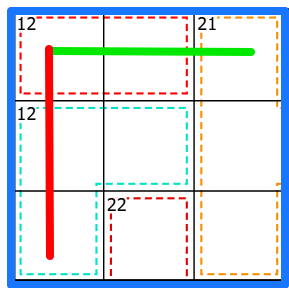
A cage is a group of cells marked off by a dotted border, with a small number in its top-left corner. That number is the cage sum — the total of the digits inside. A three-cell cage marked 15 holds three digits that add to 15.
Cage shapes are arbitrary. They can be straight, bent or L-shaped, and they can run across box borders. The clue always sits in the same place: the top-left cell. Cage size matters far more than cage shape.
3. No digit repeats within a cage
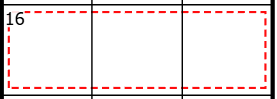
This is the rule beginners skim, and it does more work than the other two combined. It's also the rule the puzzle's own history got wrong: when the Times of London introduced Killer Sudoku to English readers on Aug. 31, 2005, it never spelled the rule out, and solvers spent weeks arguing about it.
Japanese constructors had been treating cages as repeat-free since the mid-1990s, when the puzzle circulated as samunamupure — "sum number place." That convention won, and it holds today whatever the puzzle is called: sumdoku, addoku and cage Sudoku all play by the same three rules.
The consequences are immediate. No cage can be larger than nine cells. A two-cell cage can never sum to 2, because that would take two 1s. A two-cell cage summing to 4 has to be 1+3 — 2+2 is arithmetically fine and illegal here.
What the Cages Tell You
A Killer Sudoku grid starts completely empty. That isn't a handicap — the cages are givens in disguise.
Cages aren't decoration and they aren't a math test. Each one is a constraint, and constraints are what you solve with.
Some cages have a unique answer
A two-cell cage summing to 3 is 1 and 2. There's nothing else it can be. Summing to 17? That's 8 and 9. You know the digits before you've solved anything at all — only their order is still open.
Four two-cell sums work this way: 3, 4, 16 and 17. Four three-cell sums do: 6, 7, 23 and 24. Every cage size from two through seven cells has exactly four, two at the bottom of its range and two at the top. The full list of every cage's possibilities — all 502 of them — lives here.
Even ambiguous cages help eliminate
A two-cell cage summing to 5 is either 1 and 4 or 2 and 3. That looks like weak information until you flip it: those two cells can only hold four of the nine digits, which means five digits are impossible there. Constraint runs both directions. Ruling things out wins Killer Sudoku.
Cages talk to rows and boxes
A two-cell 17-cage locks 8 and 9 into a pair of cells. If both cells sit in the same row, no other cell in that row can hold an 8 or a 9 — the pair has claimed them. Solvers call that a naked pair, and it's the single most useful pattern on the board.
Where to look first
On a fresh grid, work in this order and you'll almost always find an opening:
1. Small cages with extreme sums. Two- and three-cell cages at the very top or bottom of their range resolve instantly.
2. Cages that sit entirely inside one box, row or column. Whatever digits they lock up are gone from the rest of that house.
3. Boxes that cages almost cover. A box with one or two loose cells is the 45 rule waiting to happen.
Big middling cages are the last place to look, not the first. A five-cell cage summing to 25 has a dozen possible combinations, which tells you close to nothing on its own.
Your First Solve, Step by Step
Here's a real easy-tier puzzle we made with the help of sirxemic's SudokuApp and Sven Neumann's SudokuPad, start to finish: 28 cages, no givens, one solution. We've done our best to make this solution easy to follow for beginners, in the order you'll read them, so nothing here requires a leap you can't make.
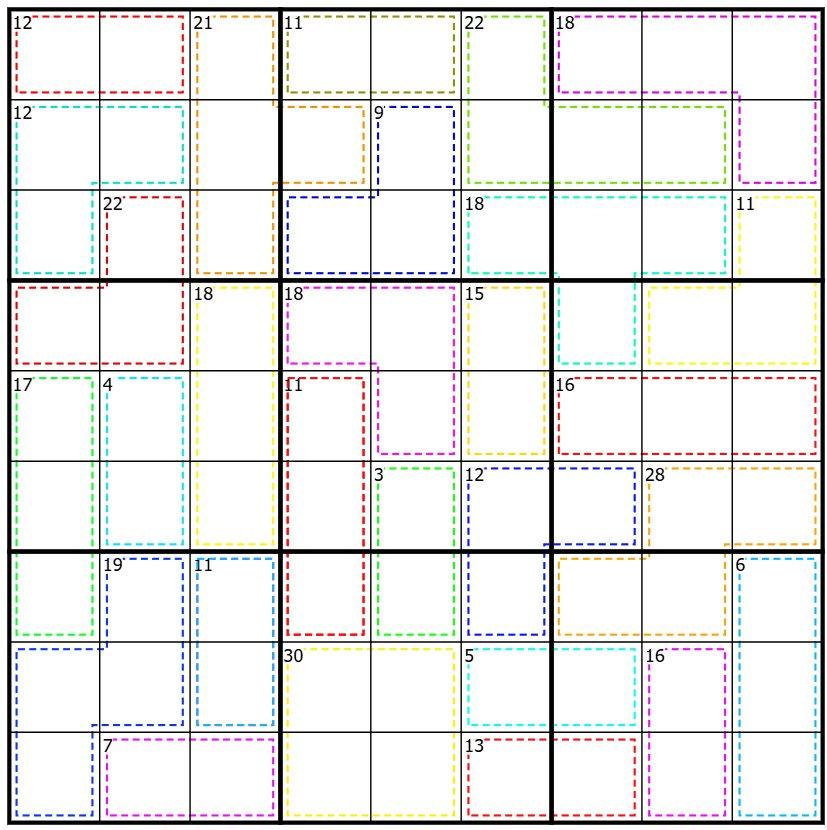
Step 1: Find a cage with one combination
Scan for the extremes. The two-cell 3-cage straddling the center and bottom-center boxes can only be 1 and 2 — nothing else works.
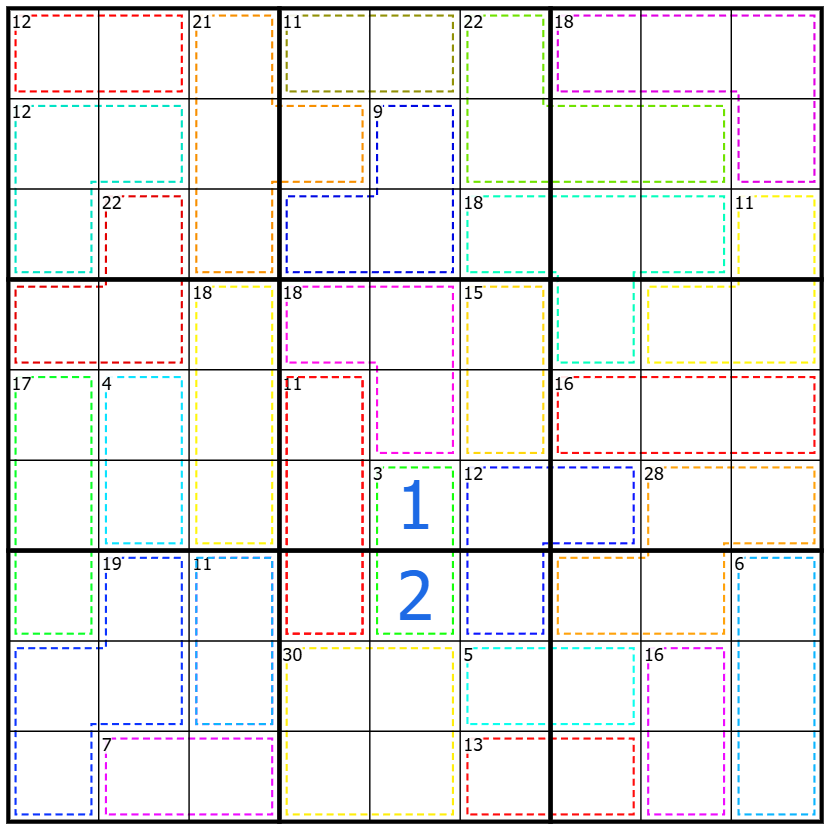
Step 2: Read the biggest cage in the same box
The 2x2 cage in the bottom-center box sums to 30. Four different digits totaling 30 leaves one option: 6, 7, 8 and 9. Those four digits are now spoken for in that box, and the 3-cage from step 1 has already claimed a 1 or a 2 there. So the four cells left over in that box can only draw from 1, 2, 3, 4 and 5.
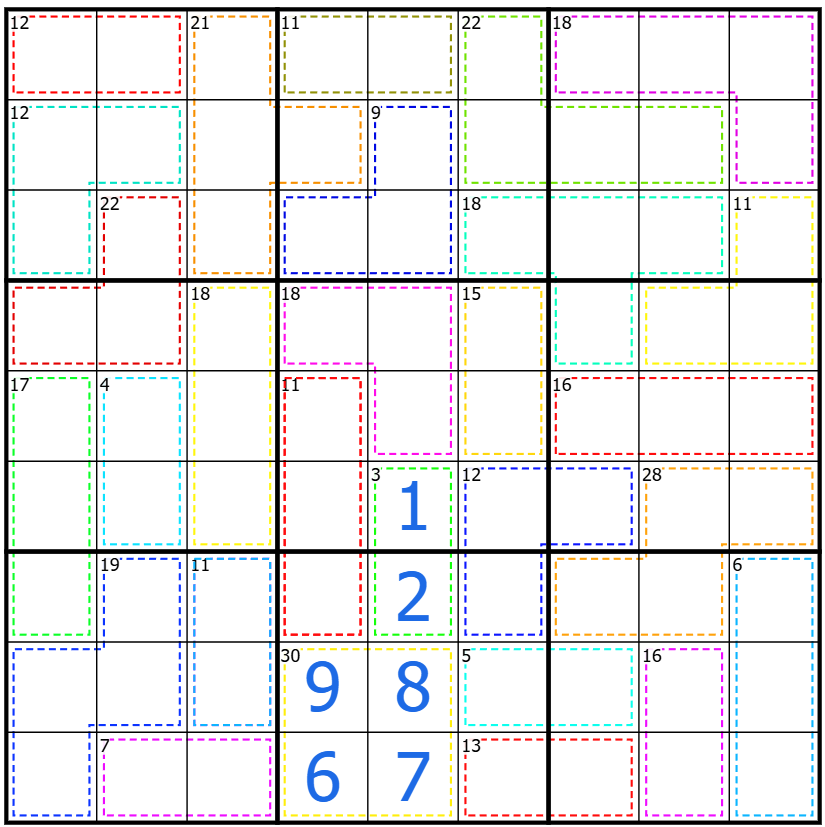
Step 3: Let a locked cage break an ambiguous one
The three-cell 6-cage runs down the far-right column inside the bottom-right box, and 6 in three cells is only 1+2+3. Every one of those cells is in that box, so 1, 2 and 3 are now banned everywhere else in it.
Now look at the two-cell 5-cage crossing from the bottom-center box into the bottom-right box. It's 1+4 or 2+3. But 2+3 would need a 2 or a 3 in that bottom-right box, and those are gone. So the cage is 1 and 4 — and since the right-hand cell can't be 1 either, it's a 4, and its partner is a 1.
Two digits on the board. Nothing harder than 2+3 required.
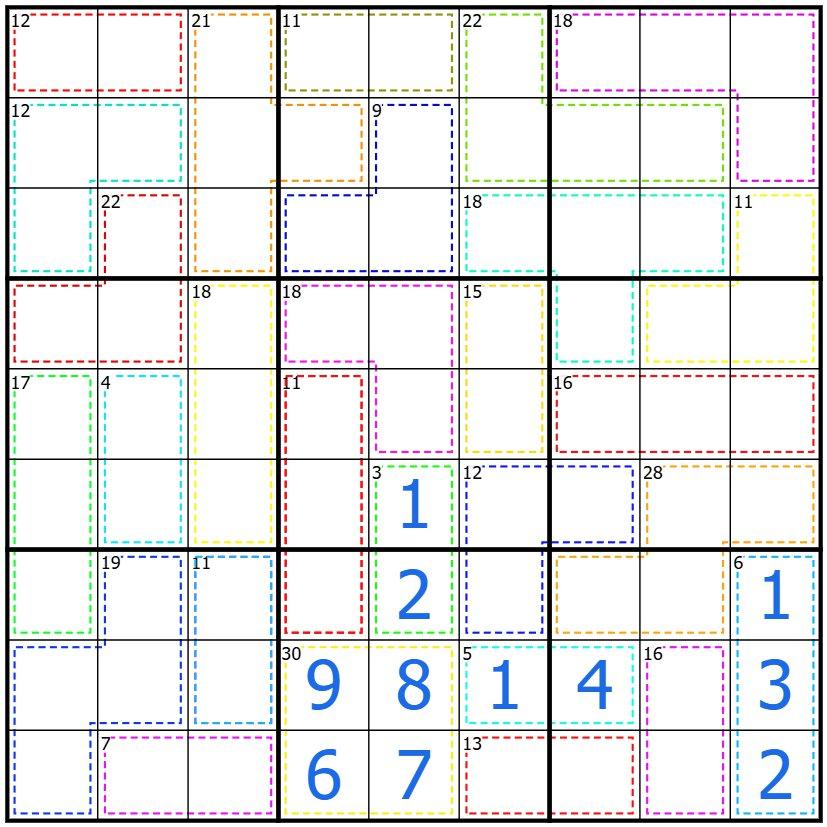
Step 4: Let rule 3 do the work alone
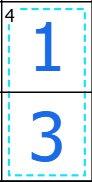
The two-cell 4-cage in the center-left box is a rule 3 problem, not a sum problem. Arithmetic allows 2+2. The no-repeat rule doesn't, so the cage is 1 and 3.
Which is which? The row you just placed a 1 in runs straight through the lower of the two cells. That cell takes the 3, its partner takes the 1.
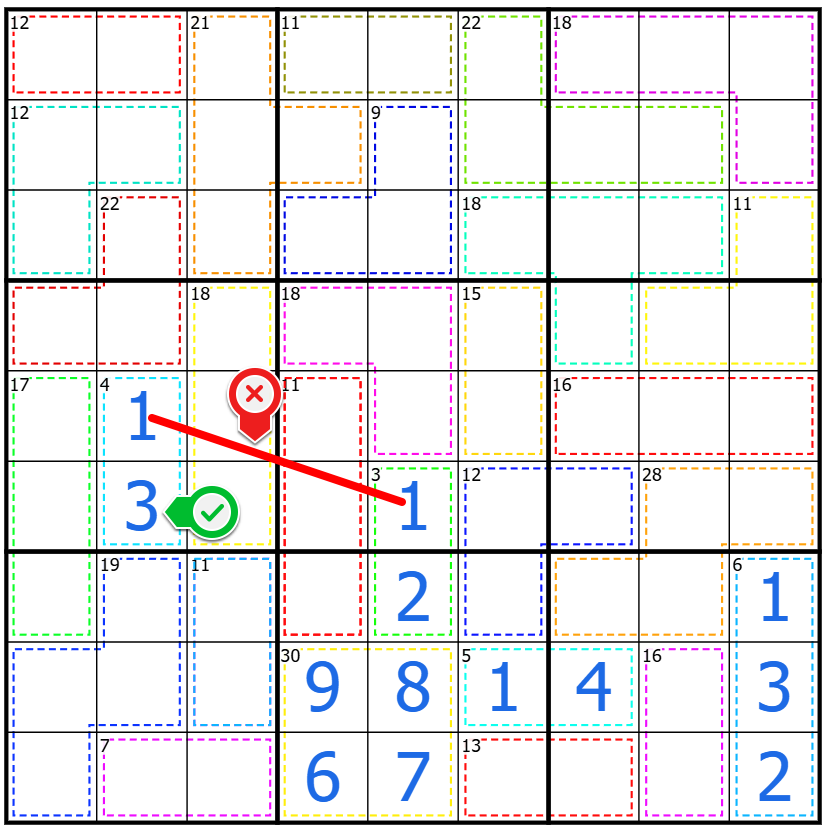
Step 5: Your first taste of the 45 rule
Look at the bottom-left box. Three cages sit entirely inside it: 19, 11 and 7. That's 37. But every box holds 1 through 9, which always totals 45. The one cell those cages don't cover has to be 45 minus 37, which is 8.
That's the 45 rule, which we'll talk about in a separate guide.
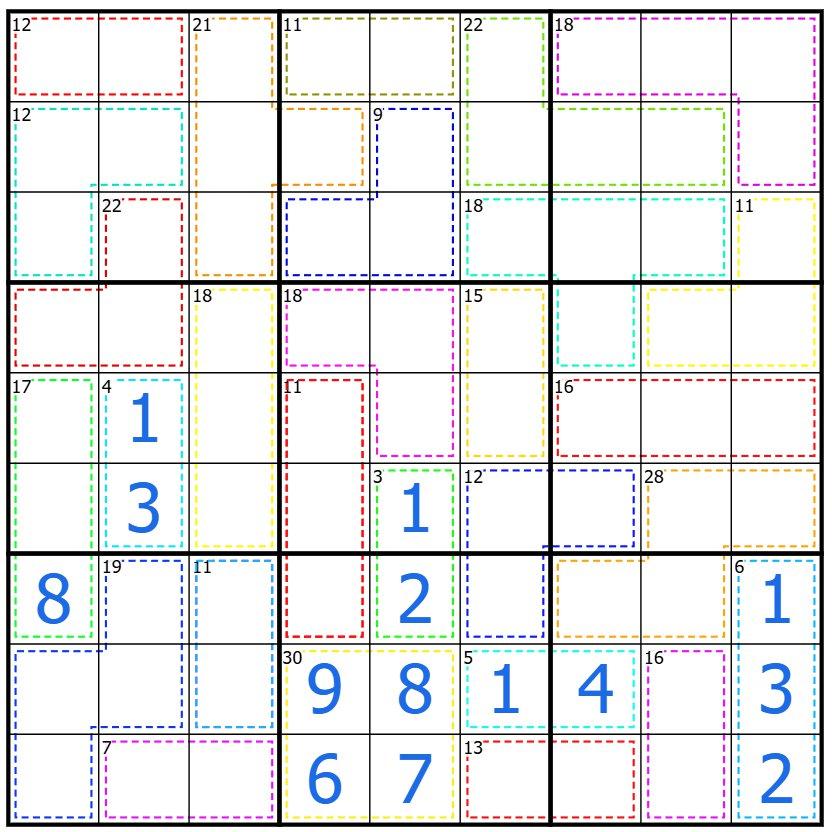
Step 7: Coast home
Seven digits is enough. From here the grid unwinds on ordinary sudoku logic — singles, pairs, the occasional glance back at a cage sum — with no technique you didn't already own before you opened this page.
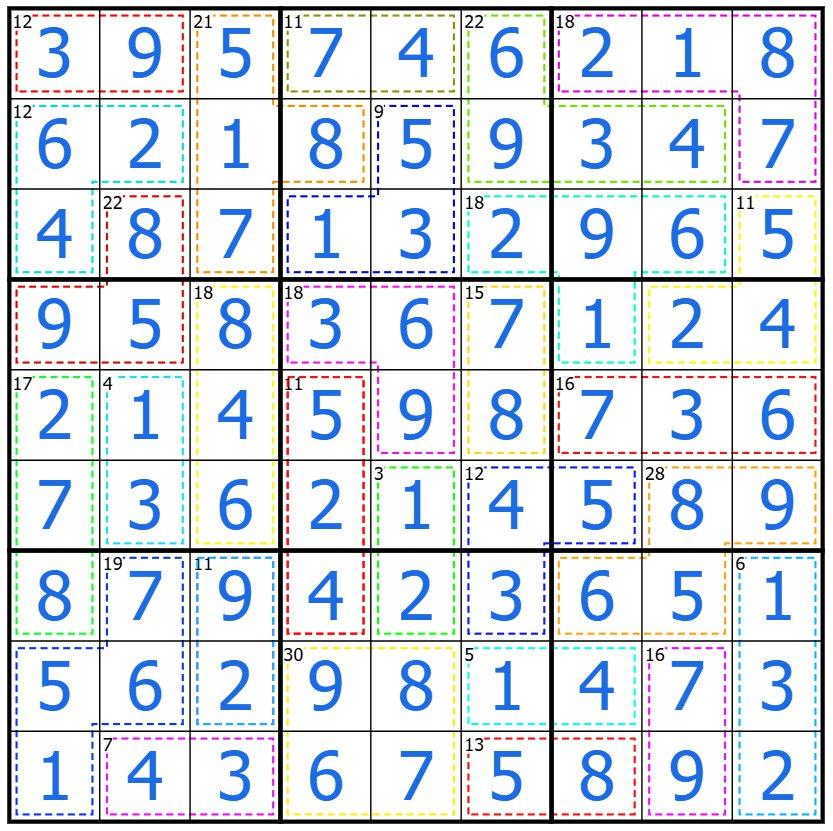
Try one yourself, and test your knowledge with an easy Killer Sudoku grid now!
What Is the Killer Rule in Sudoku?
The Killer rule is really two rules stacked on top of standard Sudoku: the digits in every dotted cage must add up to the small number printed in its corner, and no digit may appear twice inside the same cage. Everything else about the grid behaves exactly as it does in classic Sudoku.
What Is the Logic Behind Killer Sudoku?
Classic Sudoku hands you a scattering of digits and asks you to extend them. Killer Sudoku hands you arithmetic instead. Each cage sum narrows its cells to a short list of digit combinations, and the once-per-row, once-per-column, once-per-box rule then plays those lists against each other until only one arrangement survives.
That's the whole engine. You alternate between two questions — what can this cage hold, and what does the rest of the grid forbid — and each answer sharpens the other. A well-built killer puzzle never needs more than that. Ours are generated and then verified to have exactly one solution reachable by logic, so if you're guessing, you've missed something rather than hit a wall.
Is Killer Sudoku easier than regular Sudoku?
Sometimes, yes. An easy Killer Sudoku is genuinely easier than a hard classic Sudoku, because cage sums hand you more information than a sparse set of givens does. A hard classic Sudoku might give you 24 digits and no route in for 20 minutes; the puzzle above gives you nothing and still cracks open on move one.
The name oversells it. James Sinclair, who writes the Artisanal Sudoku newsletter, has stopped using the word "killer" altogether — as of 2026 he calls the format "cage Sudoku", on the grounds that the label implies a difficulty many of these puzzles simply don't have.
What decides difficulty is which techniques a grid demands, not which variant it belongs to. Our medium Killer Sudoku is where most people feel the step up.
What Is the 45 Rule in Killer Sudoku?
Every row, column and 3x3 box contains the digits 1 through 9, so every one of them sums to 45. When cages cover a box except for a cell or two, subtracting the cage sums from 45 tells you what's left.
Where to Go Next?
Three doors, depending on where you are:
Ready to play. Start with an easy Killer Sudoku grid.
Playing already and stuck on a cage. Keep the Killer Sudoku combinations table open in a second tab.
Want the technique that unlocks harder tiers. Learn the 45 rule properly.
And there's a fresh puzzle every day— completely free, no account required.
Frequently Asked Questions
Do Killer Sudoku puzzles have starting numbers?
Usually none. The cage sums are the givens. A few easy variants elsewhere seed one or two digits; ours start completely empty.
What does the dotted line mean?
It marks the cage boundary. The digits inside that outline must add up to the small number in its corner.
Can a cage cross between boxes?
Yes. Cages ignore box borders entirely, and cross-box cages are where the interesting deductions live — a cage with a foot in two boxes carries information between them.
What are pencil marks, and do I need them?
Pencil marks are the small candidate digits you note in a cell before you commit. In classic Sudoku they're optional. In Killer, they're close to essential, because cage combinations are exactly the kind of thing you'll lose track of. Our grids support them on tap or keypress.
Do you ever have to guess?
No. A properly built Killer Sudoku has exactly one solution and a logical path to it, and every puzzle on this site is verified against both conditions before it's published. If you're guessing, there's a deduction on the board you haven't spotted yet — usually a cage sum you read as ambiguous when the surrounding row or box had already narrowed it.
How long does a Killer Sudoku take?
An easy grid runs about 10 to 15 minutes for a newcomer and much less once the combinations become second nature. Expert grids can take an hour or more, which is the point of them.
 Mini Crossword
 Midi Crossword
 Diffle
 Killer Sudoku
 Numberle